Recognising the peace-loving and anti nuclear feelings of our area, Hebden Royd Town Council (HRTC) affiliated to Mayors for Peace some years ago. This international organisation, with over 1,600 members, was started by the Mayor of Hiroshima to bring together a network of towns and cities to work towards the elimination of all nuclear weapons.
Unfortunately, HRTC is not a big council, and what with one things and another - including taking over the running of the local cinema - we have not been able to play an active part in the organisation.
I wanted to change this, but didn't have an opportunity to do so until last Friday. Happily, I was invited to a meeting of the 'European and Irish Chapter of Mayors for Peace' in Manchester City Hall. I was a bit intimidated by the use of the word 'chapter', which sounds rather grand. HRTC is just a town council. As mayor, I don't even have a car and a driver and have to take the bus or the train to go to events, or ask my wife, Aeisha, for a lift. So, I travelled to Manchester last Friday by train arriving at the devastation of Manchester Victoria station, which is currently being re-roofed, and is temporarily a hell-hole of scaffolding, leaks, cramped spaces, chaos and dirt. I think the hope is that it will become some sort of bustling shopping centre, like Kings Cross. Then I crossed central Manchester to the town hall by way of the central library, which is the greatest public library building in England, and which has recently been renovated - largely, it seems, by removing the books and replacing them with interactive displays and a brightly-lit café. To be frank, I was shocked at first, but then deeply impressed by the music library, where people can play digitalised scores on electric pianos.
Anyway, after this, I walked over to committee room four in Manchester City Hall, for the start of the meeting.
I'd brought my chain but didn't wear it, as I'm not really comfortable with official regalia, though I appreciate the respect which it attracts and try to be worthy of wearing it. However, the Lord Mayor of Manchester entered in her chain. 'Oh'. I piped up,' Should we be wearing our chains'. 'Not if you don't want to', she said. 'Do you want me to take mine off?' and she handed it to an attendant.
There were representatives at the meeting of the Lord Provost of Glasgow, a Glasgow councillor, a representative of the Mayor of Leeds, the Assistant to the Leader of Rochdale MBC and others. Thankfully, the Mayor of Otley Town Council was there, so I wasn't left feeling like I'd crashed the wrong party.
The debate concerned the constitution of the group, the activities we were undertaking and our links with Hiroshima (including through the distribution of seeds from a tree that survived the blast in 1945). It was interesting to hear how much work goes into promoting peace in different councils (though I doubt it costs much on the rates, as it is often tied to other activities including tourism, with peace trails and the like).
I was left feeling very emotional because I thought politicians were no longer really engaging with internationalism and peace. In fact, there's lot of them still about, trying to promote these values, and really, really passionate about it. I was delighted that the group was keen to badge my talk about the anti-war movement in the upper Calder Valley in 1914-15 with the 'Mayors for Peace' logo. I shall be giving it again in Halifax library at lunchtime on 24 March.
Afterwards, we were shown around 'Sensory War', the exhibition on at Manchester City Art Gallery till 22 February. It's brilliant, but it includes a lot about facial disfigurement and some drawings by Hiroshima survivors representing their experiences. Some of them are naïf, but others are highly skilled contemporary drawings, referencing traditional Japanese techniques to devastating effect. There was also a number of pieces by Iranian artists about chemical warfare, based on their experiences of the Iran-Iraq war, which were superb.
Amazed and daunted, I stumbled out of the exhibition after about an hour. But I will return.
Mayors for Peace website
Sunday, 1 February 2015

Thursday, 18 September 2014
On Scottish Independence in German for the Westfalenpost
As usual, I'm at the centre of world events and my thoughts on the referendum in Scotland appeared today in the Westfalenpost. You will note that I express no preference, and restrict myself to speculating on the effect on my region if Scotland becomes independent.
Article in Westfalen post
Article in Westfalen post
Sunday, 7 September 2014
Celebrating 70 years since St Pol was liberated from the Nazis
Hebweb has an article about Hebden Royd's visit to our twin town, St Pol sur Ternoise, which highlights the role of a soldier from Hebden Bridge had in its liberation seventy years ago and the excellent oil painting that St Pol presented to Hebden Royd on our last visit in May commemorating the moment when British troops entered the town.
Hebweb article
The article was written and posted before we went to St Pol, so I should mention some of the things we did when we were there from 2 - 4 September.
This included a visit to Siracourt, a village near to St Pol, which includes the remnants of a wartime V1 bunker, that I was encouraged to clamber over with former mayors Cllrs Boggis and Dixon. The Allies dropped more bombs on this little village than anywhere else in Europe and, as a result, no V1s (the forerunner of drones) were launched at England from the site before its destruction. Walking over it was a very sombre experience, particularly as the bombing killed many of the Soviet slave labourers who built the facility and one could still see impressions of their boots in the concrete.
After the war, the village was reconstructed in a beautiful contemporary style. Its Catholic church, in particular, is a remarkable and very beautiful space, that demonstrates what can be done with wood and concrete and a good imagination working on a human scale. The wooden roof of the church arches inwards like a boat, towards a multi-coloured stained glass arch behind the alter. On either side, statues from the obliterated medieval church have been fixed to the wall. The curved skeleton of the church is constructed out of concrete and looks - though this may sound paradoxical - very attractive. The mayor's office is behind the local school, which educates 7 and 8 year olds, who then move on to other premises in a nearby village.
At the ceremony in St Pol's Salle de Fete that night, Hebden Royd was presented with a detailed DVD recounting St Pol's war experiences. This included a description of the heavy bombing of St Pol by the RAF in 1943, which resulted in substantial loss of civilian life. It was good and right to be liberated from the Nazis but the cost in terms of innocent people was high. I think I speak on behalf of the whole council in saying that the DVD is a remarkable historical record and the product of very thorough and painstaking local research.
I also had the great honour of being introduced to a member of the French resistance from St Pol. There was a translator handy, so I was able to convey the deep admiration that I have for his bravery.
During the day, I laid three wreaths on behalf of Hebden Royd: one for those who died in the fighting at the beginning and end of the war, one for those in the town who were killed by the allied bombing and finally one commemorating the railway workers who died during the war. Needless to say, I was, and continue to be, very moved by the visit.
Hebweb article
The article was written and posted before we went to St Pol, so I should mention some of the things we did when we were there from 2 - 4 September.
This included a visit to Siracourt, a village near to St Pol, which includes the remnants of a wartime V1 bunker, that I was encouraged to clamber over with former mayors Cllrs Boggis and Dixon. The Allies dropped more bombs on this little village than anywhere else in Europe and, as a result, no V1s (the forerunner of drones) were launched at England from the site before its destruction. Walking over it was a very sombre experience, particularly as the bombing killed many of the Soviet slave labourers who built the facility and one could still see impressions of their boots in the concrete.
After the war, the village was reconstructed in a beautiful contemporary style. Its Catholic church, in particular, is a remarkable and very beautiful space, that demonstrates what can be done with wood and concrete and a good imagination working on a human scale. The wooden roof of the church arches inwards like a boat, towards a multi-coloured stained glass arch behind the alter. On either side, statues from the obliterated medieval church have been fixed to the wall. The curved skeleton of the church is constructed out of concrete and looks - though this may sound paradoxical - very attractive. The mayor's office is behind the local school, which educates 7 and 8 year olds, who then move on to other premises in a nearby village.
At the ceremony in St Pol's Salle de Fete that night, Hebden Royd was presented with a detailed DVD recounting St Pol's war experiences. This included a description of the heavy bombing of St Pol by the RAF in 1943, which resulted in substantial loss of civilian life. It was good and right to be liberated from the Nazis but the cost in terms of innocent people was high. I think I speak on behalf of the whole council in saying that the DVD is a remarkable historical record and the product of very thorough and painstaking local research.
I also had the great honour of being introduced to a member of the French resistance from St Pol. There was a translator handy, so I was able to convey the deep admiration that I have for his bravery.
During the day, I laid three wreaths on behalf of Hebden Royd: one for those who died in the fighting at the beginning and end of the war, one for those in the town who were killed by the allied bombing and finally one commemorating the railway workers who died during the war. Needless to say, I was, and continue to be, very moved by the visit.
Wednesday, 27 August 2014
Caroline Gooding's obituary from the Guardian
Please read the following obituary of a former colleague, whose work to realise the rights of disabled people continues. Caroline did not just have an outstanding mind, she was also a very nice, very modest person.
Caroline Gooding's obituary by Bob Niven
Caroline Gooding's obituary by Bob Niven
Sunday, 24 August 2014
Your Ideas on Local Planning Rules, Please
If you live in Hebden Bridge, Mytholmroyd, Cragg Vales or any of the surrounding hilltop settlements, please contribute to this thread on hebweb asking for ideas for our neighbourhood plan.
The plan brings together Hebden Royd Town Council with Blackshawhead, Erringden, Heptonstall and Wadsworth parishes in our most ambitious partnership. All will be explained if you read the post!
http://www.hebdenbridge.co.uk/forum/2014/072.html
The plan brings together Hebden Royd Town Council with Blackshawhead, Erringden, Heptonstall and Wadsworth parishes in our most ambitious partnership. All will be explained if you read the post!
http://www.hebdenbridge.co.uk/forum/2014/072.html
Tuesday, 5 August 2014
Resistance to the War: The Independent Labour Party in Hebden Royd and the Sowerby Division in 1914 -15

Fenner Brockway, Editor of the ILP newspaper, Labour Leader, 10 September 1914
This article explores the history of
the Independent Labour Party (ILP) during the years 1914 and 1915, in the area
now covered by Hebden Royd Town Council. To do so, it sometimes goes wider and
considers the politics of the Sowerby Parliamentary Division, the forerunner of
Calder Valley constituency, because local ILP activity often took place on a
divisional, rather than at a local branch level. Before reading it, it is worth bearing in mind that the British Expeditionary Force was a volunteer army before 1916 and no one was forced to serve in it before then. So there were no conscientious objectors until 1916. Those who opposed the war in 1914 and 15 expressed their opposition by refusing to take part in recruitment campaigns and arguing for an early peace settlement.
The ILP was once the largest
democratic socialist party in Great Britain; it co-founded the Labour Party and
remained affiliated to it until 1932. It is managed, then as now, by the
National Administrative Council (‘the NAC’), a decision-making body that acts
in accordance with members’ wishes.
The Sowerby Division Labour Representation
Association (‘Sowerby LRA’) was the embodiment of the Labour Party within the
Sowerby Parliamentary Division. At the time, the Labour Party was an electoral
pact between the trade unions and socialist societies and parties, including
the ILP, dedicated to winning independent working class representation in
council and parliamentary elections.
The ILP in the West Riding
The ILP’s connections in the West
Riding and East Lancashire were particularly strong. It was founded in Bradford
in 1893. The ILP’s first treasurer was John Lister of Shibden Hall, Halifax.
Philip Snowden, MP for Blackburn in 1914, started his political life in
Keighley ILP. It held its ‘coming of age’ conference in Bradford in April1914.
And there was a delegate from Hebden Bridge ILP present, a Mrs J
Wheelhouse. It seems likely that she was Nancy Wheelhouse, a fustian machinist,
who lived in Eton Street, with her husband, Joseph, also a fustian worker and
executive member of Sowerby LRA.
The ILP in the Upper Calder Valley in
1914
Mrs Wheelhouse was not a lone voice
in Hebden Royd or the upper valley. Records show that during the period
immediately preceding WW1, and just after war was declared, there were ILP
branches in Luddendenfoot, Mytholmroyd, Hebden Bridge, Charlestown, Todmorden,
Ripponden and Sowerby Bridge. The minute book of Sowerby LRA makes reference to
an ‘ILP institute’ in Hebden Bridge, but nothing is known about its location,
size or longevity.

The ILP responds to the War

The ILP responds to the War
When war was declared on 4 August
1914, the ILP took a firm stance in opposition to it. Its newspaper, the
Labour Leader ran a statement on its front page which read “Workers
of Great Britain, you have no quarrel with the workers of Europe. They have no
quarrel with you….This is not your war. It is the war of the British ruling
class, of the German ruling class, of
the French Ruling Class and of the
Austrian ruling class….Down with the war!’
Subsequent editions and pamphlets
spelled out a series of political aims to rid Europe of future wars. These
included:
·
An end to ‘secret diplomacy’
·
Peace on non punitive terms
·
Condemnation of the influence of private
profit in the arms industry
·
The creation of a united states of
Europe and international courts of arbitration
The National Administrative Council immediately
declared that the ILP and its branches would not help recruit volunteers for
the war. On 24 September 1914, Labour Leader announced on page 7
that a conference of ILP branches
representing Huddersfield, Halifax, Sowerby, Holmfirth and Dewsbury
Parliamentary Divisions had passed “a resolution…. unanimously and
enthusiastically ….. endorsing the policy of the National Administrative
Council”. Two days later Sowerby LRA resolved ‘that we as an executive cannot
see our way to take part in any recruiting but allow each individual member to
use their own discretion’. In doing so, it expressly rejected the Parliamentary
Labour Party’s position seen in the minutes below.
So, in substance, Sowerby LRA took
the same position at the time as the ILP. This anti-war spirit was reflected
nationally by the resignation of ILP member Ramsay MacDonald as Chair of the
Parliamentary Labour Party (effectively, leader of the Labour Party) because it
decided to vote for ‘war credits’ (i.e. funding the war). He was replaced by
Arthur Henderson, who was not an ILP member, and who later served in the
coalition war cabinet in 1915. In time, Sowerby LRA would move away from the
local ILP branches and towards the position represented nationally by
Henderson.
Sowerby LRA breaks with the ILP
During 1914 and most of 1915, the
local ILP branches and Sowerby LRA appear to have maintained apparent unanimity
about the war.
Indeed, in early 1915, Hebden Bridge
ILP remained defiantly optimistic. Undeterred by recruitment fever, the branch
held their ’annual business meeting’ at the Trades Club (reported in the Hebden
Bridge Times on 12 March 1915). The report says ‘the branch has had a very
successful year. ‘Mr (sic) N Wheelhouse’ was elected auditor. Apparently,
'a vegetarian supper was served,
which consisted of the following: tomato and nut soup; vegetarian pies with
potatoes, roasted in butter; mock salmon steaks; macaroni cutlets; savoury
gravy. Mr W Robertshaw, of Eastwood, was the caterer’.
The picture of vegetarian pacifists
enjoying a meal together in the Trades Club may sound strangely familiar, but
we should recall that Nancy and the others were working people likely to have
only a rudimentary formal education.
They were also likely to have been the odd ones out in a town that was
sending more and more recruits to the front.
So, the pressure to change must have
been immense. Eventually, on 24 October 1915, the Sowerby LRA executive broke
with the ILP. The minute book reads: ‘Resolved that as an executive we take
part in the joint Labour recruiting campaign.” Perhaps as a face saver, and
compromise with ILP comrades, it continues ‘resolved that this executive press
upon the Labour party to oppose conscription unless it is accompanied by the
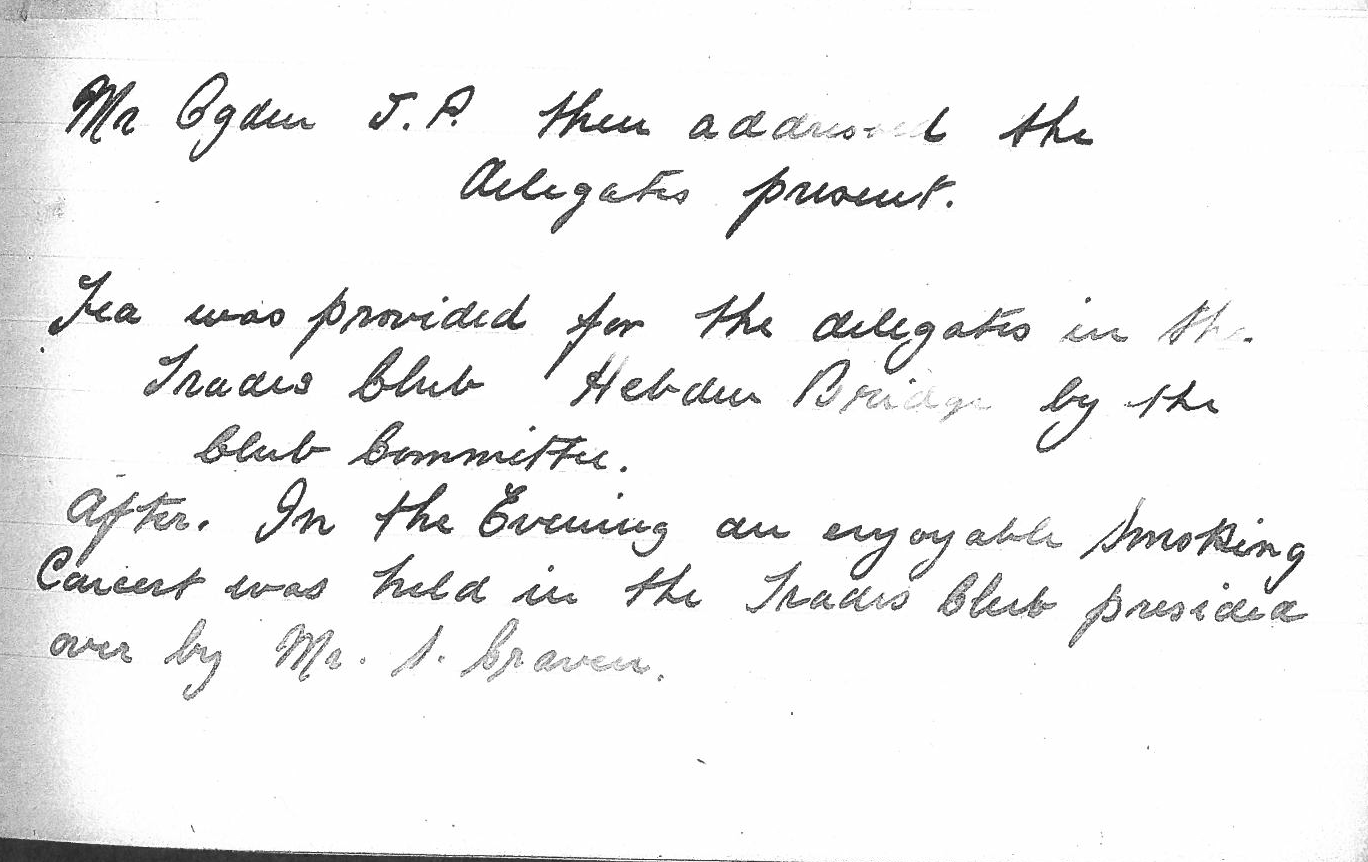
conscription of all the material wealth of the country’. ‘Mr Ogden JP’ (the
Labour Party parliamentary candidate at the time) ‘then addressed the delegates
present’. Did Ogden attend to help assert Labour Party pragmatism over the
ILP’s anti-capitalist pacifism, or was he there co-incidentally to address the
meeting on another matter? Whatever happened, afterwards we know that ‘tea was
provided ….in the Trades Club Hebden Bridge by the Club Committee. After, In
the Evening an enjoyable Smoking Concert was held in the Trades Club’.
Even if the ILP was no longer
dominating Sowerby LRA politically, it still continued to be the most outspoken
source of views that were widespread in the Labour movement and perhaps amongst
some upper valley Liberals as well. These views were expressed by the Hebden
Bridge Labour and Trades Council in1915, in its annual statement to the Hebden
Bridge Times:
The nations of Europe have been
plunged into the greatest war the world has ever known. Militarists and
diplomats have succeeded in bringing this awful calamity upon the nations
without consulting the workers in any of the countries involved….We sincerely
trust that the war will end militarism and secret diplomacy; that it will
destroy forever the accursed profit-making armament rings; and that democracy
will assert its power in demanding that international disputes shall in future
be settled upon the lines of reason and arbitration, common sense and justice.
They were echoed at Eastwood, where
the Liberals, in their first annual meeting after the declaration of war,
discussed ‘the ending of the dismal system of secret diplomacy…the abolition of
private profits out of armaments construction, and…the establishment of a
permanent court of arbitration to which all international disputes shall be
referred’.
All of which would have been familiar
sentiments to the ILP branches in the upper valley, and in particular to that
inveterate ILP annual meeting attender, Nancy Wheelhouse.
Cllr Jonathan Timbers (ILP)
Note on sources
This paper explores the history of
the Independent Labour Party in Hebden Bridge, Mytholmroyd and Cragg Vale,
during the years 1914 and 1915. Because evidence is sketchy, it goes even wider
and considers the Sowerby Parliamentary Division, the forerunner of Calder
Valley constituency. However, national ILP sources have been consulted to find
out more about the politics of the ILP, as local records are almost entirely
silent as to the views of Hebden Royd’s ILP-ers.
Thanks to Calder Valley Constituency
Labour Party and Independent Labour Publications for permission to reproduce
primary sources. Thanks also to my friends, Mike Crawford and Barry Winter
(ILP), for their advice on the text. I dedicate this piece to Mrs Nancy
Wheelhouse and the thousands of other comrades from the ILP who worked to make
peace and social justice a reality, without seeking office or thanks.
Sunday, 3 August 2014
Reflections on World War One - My Speech at Hebden Royd's Commemoration Event today

I want to make three points during this reflection on
World War One:
·
Firstly, that WW1 is not really history at
all, not quite yet. The personal impact of that war is still felt by living
people, some of whom are here today.
·
Secondly, the world we live in now was born out of WW1
and we still live under its shadow
·
And thirdly, that this commemoration is about
everyone who was affected by that war, men, women, children, those who went,
those who stayed home, the refugee who fled, those who believed in the war and
those who said they didn’t. We also mark the terrible losses suffered, amongst
others, by the French, German, Russian, Austrian and Turkish peoples. And the
contribution by soldiers from the British and French empires, from the west
Indies and Africa, from Algeria and India and Pakistan, remembering that the first
round fired by a soldier in British military service in WW1 took place in Togo,
Africa, the soldier’s name, Sergeant Major Alhaji Grunshi
To begin on a personal note, I consider myself to be one
of those personally affected by world war one. My half-German grandfather James
Timbers died just before I was born, partly from injuries he sustained fighting
for the British in the Battle of Mons. To paraphrase the words of the poet
Jenny Lewis, writing about her father who served in Mesopotamia, ‘I’ve spent the rest of my life looking for
him’.
I am not alone. Today, we are privileged to have Phylis
Walstow with us, who lost her father in 1915, as well as other children of WW1
veterens, including my mother, Roma. Many of them saw at first hand the
personal cost of that war and by that I mean damaged minds and damaged hearts,
and damaged communities…described by Ted Hughes in his poem ‘Dust as we are’,
about his father, a WW1 veteran, living with his post-war family in Mytholmroyd:
He
had been heavily killed. But we revived him.
Now
he taught us a silence like prayer.
There
he sat, killed but alive…
And
I filled
with
his knowledge
After
mother’s milk,
This
was the soul’s food.
And in a sense all of you here today - even my six year old daughter - live in the
shadow of that war.
In drafting this reflection, I’ve tried on several
occasions to explain why but found myself inadequate to the task. Luckily, on
Friday, the Institute for Public Policy research drew my attention to an essay by
the historian Heather Jones, which explains why the war is still relevant to us
far better than I ever can. In summary she argues that the Left Right debate
about whether WW1 was an imperialist or a patriotic war of defence is beside
the point – because of course historically speaking the war was both. It was not
primarily a war between Britain and Germany, let’s not forget it started in
Serbia and British troops including my granddad Timbers also fought in Italy
against Austrians and Hungarians, others
fought in Gallipoli. It began the ruthless occupation practices perfected by
the Nazis in the second world war. It lead to the breakdown of multi ethnic and
multi religious empires and the creation of ethnic nation states, the arbitrary
division of the Middle East and the foundation of the state of Israel . Looking
at Al Jazeeri and the Observer this morning, I wondered if WW1 was entirely
over yet.
The war also left us with three great positive ideas –
largely from those who opposed it – that now dominate politics and the economy
in the UK and the world. The creation of an international court of arbitration
to stop disputes from spiralling out of control – we call it the UN – and a
‘league of Europe’ or ‘united states of Europe’ – we call it the EU – and
finally, free trade, though how free it is actually in practice these days is
sometimes hotly debated.
To turn to my third and final point: today, we commemorate all those who lived
through world war one, and in particular the early stages of the war, as there
will be further commemorations in 2016 and 2018 to mark the later stages of the
conflict. So one of the things we should focus on today is the extraordinary
story of the mass mobilisation of volunteers in the United Kingdom in the early
stages of the war. Incredibly, the UK avoided conscription until 1916. So there
was no conscientious objection to the war until then, although there was certainly
opposition to it, locally as well as nationally. I have written a slim piece
about that, which you can pick up for free, if you want to, at the back.
Primarily though, people supported the war, largely, though not always, I
believe, for idealistic reasons, which go well beyond patriotism, or what the
Minister of Hope Baptist Church described in this place, in 1915 as ‘devilish
jingoism’. They believed that through self-sacrifice they could end all wars.
In the words of the Hebden Bridge Times from 6 August 1915, ‘we took up arms to
ensure that even the strongest power shall not be free to disregard
treaties…and that even the weakest power shall be at liberty to live its own
life’. In other words, they went to war to create a civilised international
order, where the strong protect the weak against aggressors, and the force of
international agreement would in future prevent all war. Their hopes were
betrayed, but that is another story
Let me begin to conclude with their words, which you can
read in Mike Crawford’s powerful account of the experiences of local soldiers
in the first few weeks of the war. They were written by Lieutenant Owen from
the second battalion the Duke of Wellington’s regiment at the end of September
1914:
“I have not met a single man (or horse) of the English,
French or German armies who is not dying for the war to finish!...if all goes
well, we ought to win the victory which swallows up all strife, like Waterloo;
and that ought to keep peace for say 50 years. By that time I think the really
universal feeling against war will make soldiers a thing of the past’.
You can buy Mike’s book at the back. I recommend it
highly.
Finally, let me draw your attention to my charities: chosen with WW1 in mind. The St Augustine
centre in Halifax which does many things but primarily helps asylum seekers and
refugees, is something I am passionate about, along with the Archbishop of
York, the Right Reverend John Sentanu, who said “If we could replicated this in every community, the
country would be a different nation.”. We had many refugees in
this valley in 1914 and 15, from Belgium, but then they were welcomed, and
employers who exploited them were criticised. The status of refugees has
worsened somewhat over the last century, even though there are considerably
fewer around today than in WW1. I am no preacher but I think the words of St
Matthew Chapter 25 verses 34 and 35 are apposite: ‘Come, you who are blessed
by my Father; take your inheritance, the kingdom prepared for you since the
creation of the world. 35 For
I was hungry and you gave me something to eat, I was thirsty and you gave me
something to drink, I was a stranger and you invited me in’.
My other charity is Combat Stress, that was set up after
WW1, to provide counselling for veterans with PTSD or ‘shell shock’, as it was
known then. Too many are still coming home with no help or support, some end up
out on the streets, all too frequently their families find them too difficult
to cope with and break up. You would have thought that abandoning our veterans
was a practice that would have ended soon after the eighteenth century, not
something that persists in the twenty-first. Sadly not.
I thank you for your generous donations, remembering the
number of refugees out there in a world that is still at war and the trauma that
many veterans are left with, confronted by so much senseless death and
suffering. These are amongst the long shadows that WW1 leaves us with.
Subscribe to:
Posts (Atom)